
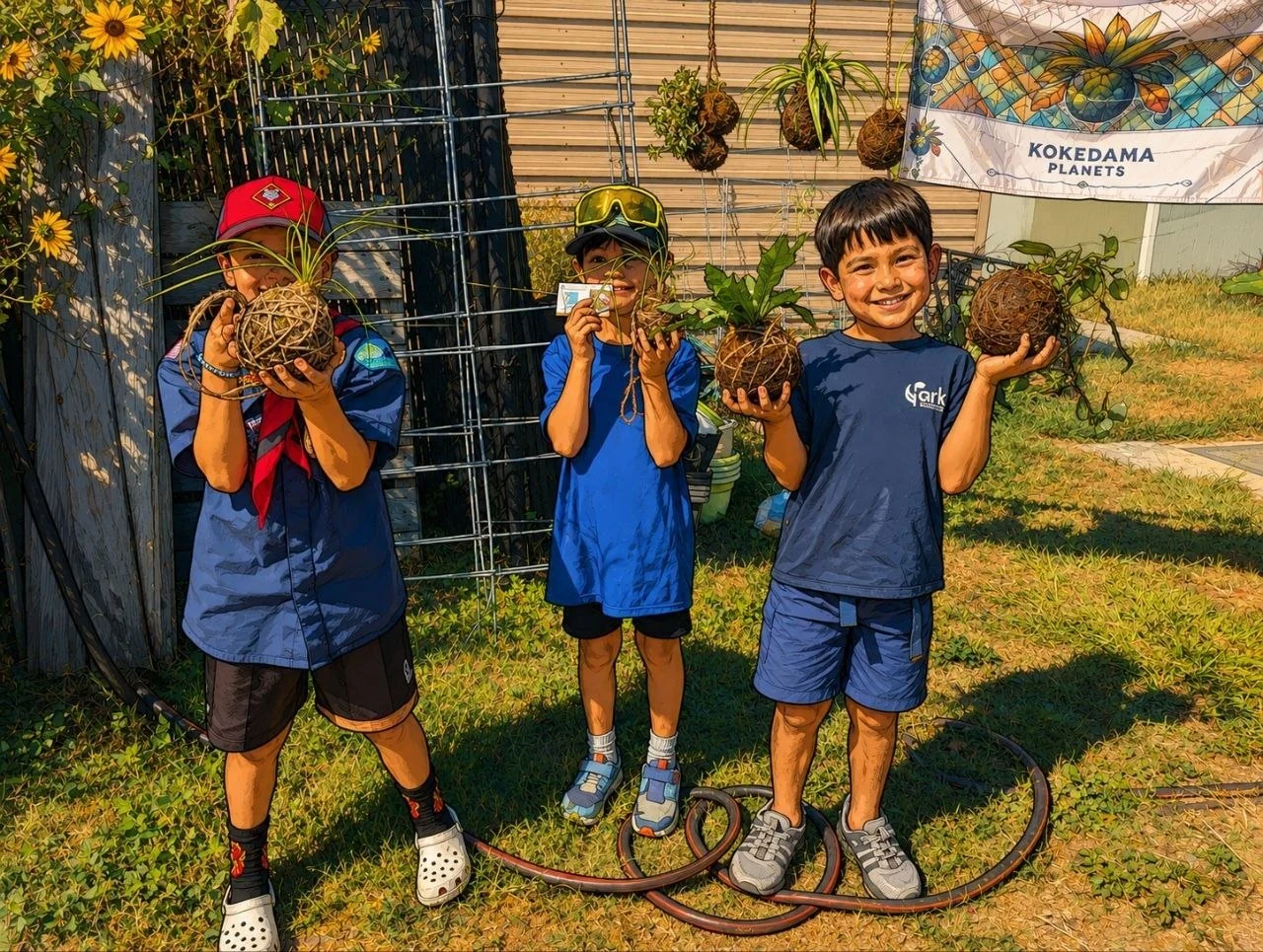
Sebastian is part of our local Cub Scout troop, and Ashley has been building hands-on garden and nature learning through Meyer Lemon. She loves creating activities where children can work with living materials, ask questions, and practice care in a real way.
This fall, Sebastian and Ashley brought that approach to his fellow Cub Scouts by hosting a kokedama workshop as part of their sustainability badge work.
Kokedama are moss balls that hold and care for a plant using simple natural materials. Instead of a plastic pot, the roots are wrapped in soil, moss, and string. They are beautiful, but they are also a good teaching object: you can hold one in your hands and talk about soil, roots, water, air, plant care, and the materials we choose to use.
Talking about natural resources
Before everyone started building, we talked about natural resources and what it means to conserve them. The scouts were working with living plants, moss, string, soil, and water. Every part of the project invited a question:
What do plants need?
Where do those materials come from?
How can we care for something without wasting what it needs?
Why does water matter so much, especially in a garden?
That last question became very real very quickly.
When we went to use the garden hose, we realized it was completely shut off. No running water.
Suddenly the conversation about conserving resources was not just a badge topic. It was the actual problem in front of us.
The water rescue team
The group rallied.
Some friends brought a cooler full of water from a nearby neighbor. Sebastian and Javier went back home to get a large jug of water. Since it was a warm day and everyone was working hard, they also brought back fresh popsicles for the scouts.
It was such a simple thing, but it changed the energy of the whole workshop. The kids could see that water was not just something that appears when you turn a handle. It had to be found, carried, shared, and used thoughtfully.
That is a powerful lesson.
Sometimes sustainability sounds like a big adult word. In that moment it looked like families helping each other, scouts carrying supplies, kids waiting patiently, and everyone understanding that one cooler and one jug of water mattered.
Making something living with your hands
Once the water was sorted, the workshop became joyful and messy in the best way.
The scouts shaped their soil, wrapped moss, tied string, tucked in plants, asked questions, compared designs, and helped each other. Families worked side by side. Every kokedama came out a little different, which is part of the charm.
Some were neat and round.
Some had wild strings.
Some looked like tiny planets with plants growing out of them.
All of them were made by hand.
And because the kids had just experienced the water problem together, caring for the finished kokedama felt more meaningful. These little moss balls were not decorations. They were living things that needed attention, water, and care.
What stayed with us
One of the nicest parts has been seeing those kokedama again later, when we visit friends for birthdays and house parties. A project that started at a scout workshop kept living in people’s homes.
That is the kind of learning we love.
A badge requirement became a community garden day.
A craft became a conversation about resources.
A broken hose became a real lesson in conservation.
And a group of scouts got to leave with something living that they made with their own hands.