
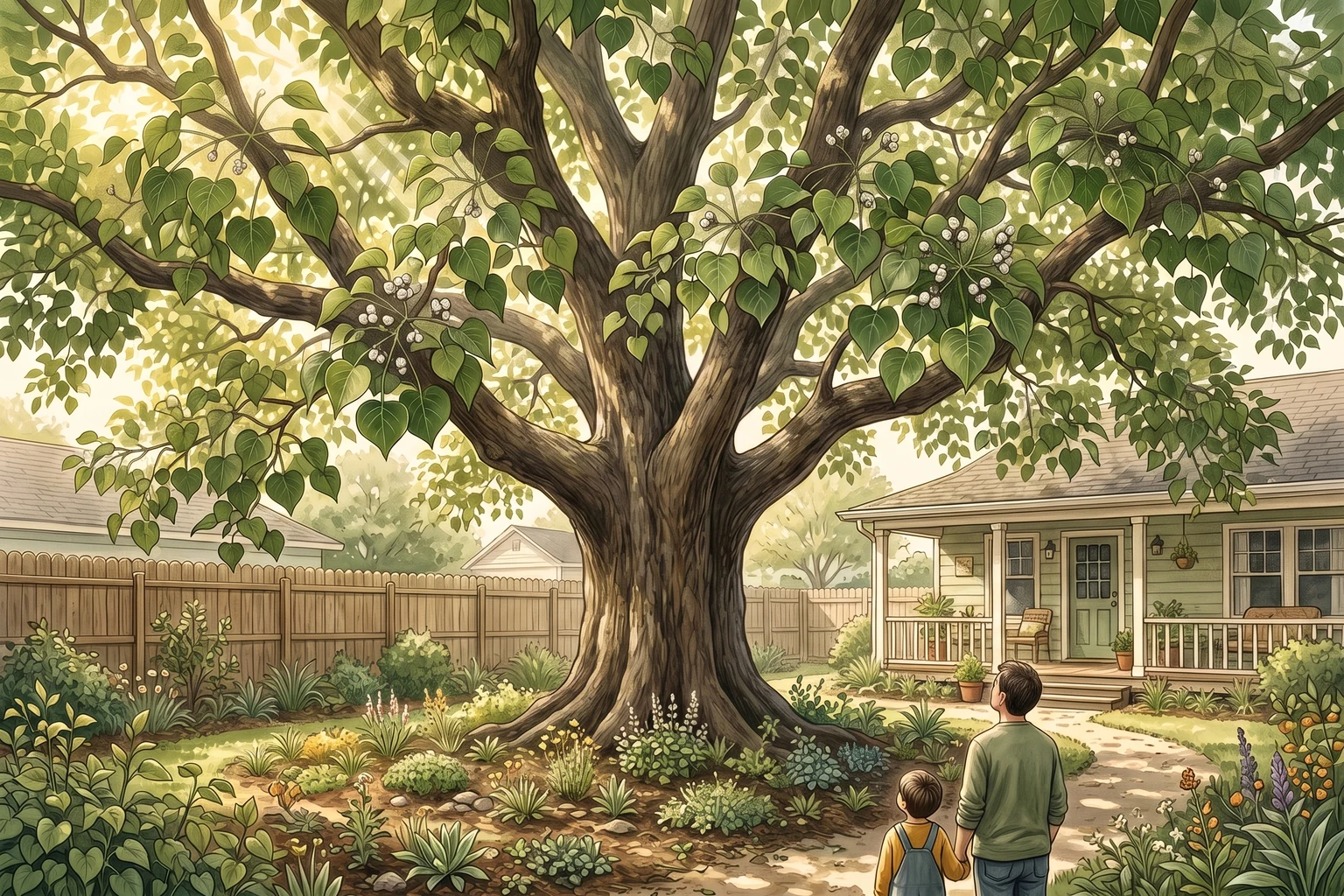
There is a tree in our backyard so large that it feels less like one plant and more like part of the property itself.
It casts shade, shapes the view, and influences nearly everything growing beneath it. We do not know exactly when it was planted, but it may have been there for around 30 years.
We have recently learned that this giant is a Chinese tallow tree.
What is Chinese tallow?
Chinese tallow (Triadica sebifera), sometimes called popcorn tree, was introduced from Asia and planted as an ornamental. Its quick growth, heart- to diamond-shaped leaves, bright fall color, and clusters of white seeds helped make it appealing in landscapes.
Those same qualities also help it spread far beyond the place where it was planted.
An invasive plant is not simply a plant someone dislikes. It is a non-native species that spreads and causes, or is likely to cause, ecological or other harm. Chinese tallow fits that definition in several parts of Texas, especially along the Gulf Coast.
Why it matters in Houston
Chinese tallow establishes easily, grows quickly, and produces large quantities of seed. Birds and water can carry those seeds into nearby yards, woodlands, wetlands, and prairies. When a tree is cut without an effective follow-up plan, it can also resprout from its crown or roots.
Over time, dense stands can push out native vegetation and change the structure of habitat. Texas A&M Forest Service describes Chinese tallow as a serious invader that has contributed to the conversion of upper coastal prairie into woodland, reducing habitat for wildlife tied to open prairie.
This is why one tree in one yard is connected to a much larger landscape. The seeds do not recognize a fence line.
Then we looked at our own backyard
This is not an abstract invasive-plant lesson for our family. We have one.
Ours is massive. It may be decades old, and it has become one of the dominant features of our backyard. We are currently thinking in a broad working range of roughly $2,000 to $5,000, depending on access, proximity to structures, equipment, hauling, stump work, and the final scope.
That price is significant. So is the ecological opportunity.
Removing a mature invasive tree is not as simple as subtracting something unwanted. A tree this large holds shade, affects soil moisture, offers perches and cover, and creates the conditions that the rest of the yard has adapted to. Taking it out could suddenly turn a shaded area into a much hotter, brighter space.
A tree can be invasive and still be woven into the story of a home. Both things can be true. Responsible change means paying attention to what will be lost as well as what could grow in its place.
What we need to figure out
We are treating this as a process rather than a one-day removal project. Before making a final decision, we want to work through questions like:
- What does a certified arborist see when they assess the tree, its condition, and its proximity to structures?
- What should a complete quote include: safe removal, stump management, hauling, site protection, and follow-up?
- Can some of the wood be reclaimed for art or maker projects instead of being discarded?
- How do we prevent resprouting and monitor the seed bank while staying as close as possible to our chemical-free values?
- How will the backyard's sun, heat, water, and planting conditions change?
- Which native canopy trees and understory plants could rebuild shade and support more local life over time?
We do not have all of those answers yet, and we do not want to pretend that we do.
Follow the backyard transition
This post is the beginning of a series. We plan to share what we learn as we compare professional recommendations, think through the cost, decide how to handle the tree and its wood, map the changing shade, choose native replacements, and watch how the backyard responds.
Our hope is that showing the whole process—including the uncertainty, trade-offs, and follow-up—will be useful to other families who discover that a familiar tree is also an invasive one.
Stay tuned. The giant in our backyard has given us a very big place to begin.