
At first, it feels like a craft. You gather the materials, shape the soil, wrap the moss, tie the string, and suddenly there is this little living sculpture sitting in front of you. It is beautiful and satisfying in the way a finished craft is satisfying.
Then the next day comes.
The moss feels a little different. The ball is not quite as heavy. The plant may be leaning toward the light. A few days later, the whole thing feels lighter in your hand, and now the project is asking for something.
That is where the real learning begins.
A plant you can hold
Kokedama gives kids a very simple way to notice plant care with their bodies. Instead of starting with a rule like “water every few days,” they can begin by picking it up.
Is it heavy or light?
Cool or warm?
Damp or dry?
Soft, springy, crumbly, or crisp around the edges?
Those small observations matter. They help children build a relationship with the plant instead of just following instructions. The kokedama becomes something they check in on, not something they made once and forgot.
For younger kids especially, touch can come before explanation. They may not understand evaporation, humidity, drainage, or root uptake yet, but they can absolutely feel the difference between “full of water” and “ready for a soak.”
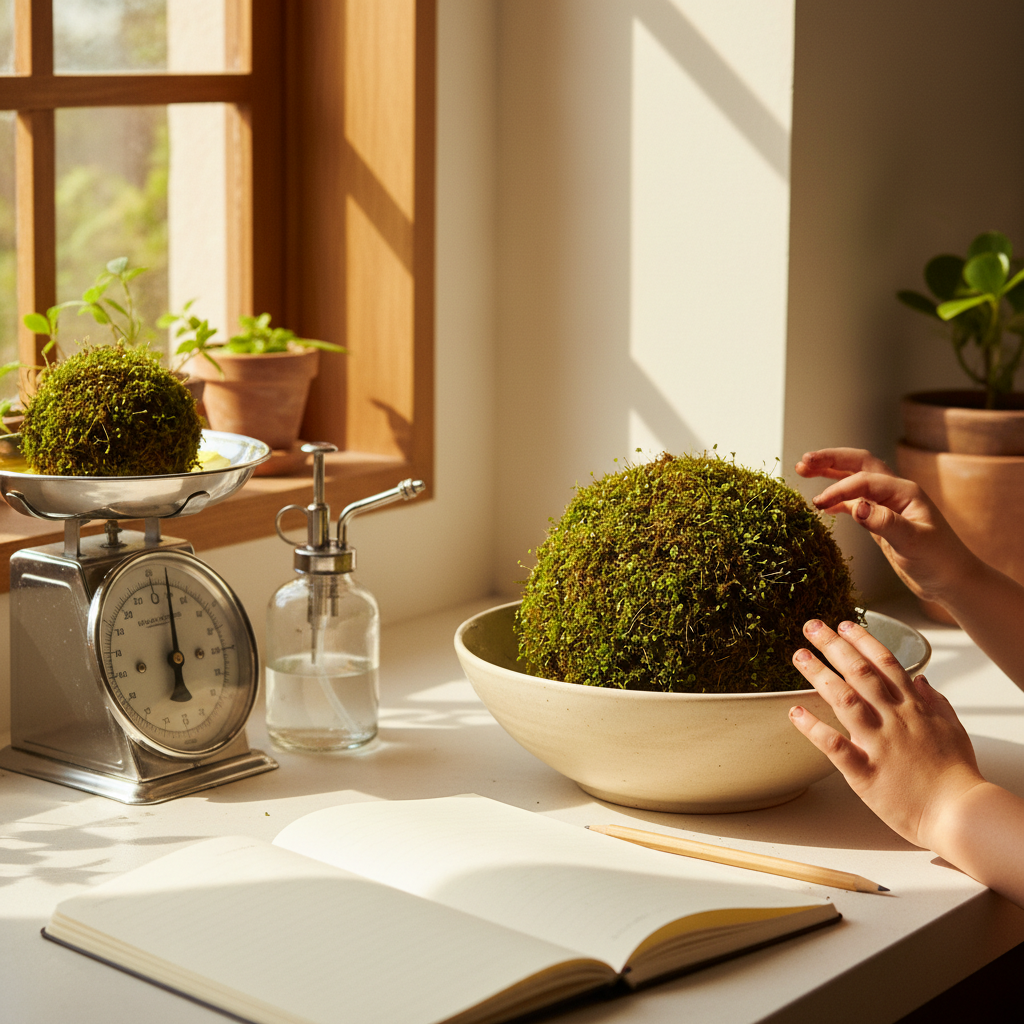
Try a kokedama weigh-in
This is a simple activity we can use after making a kokedama, or anytime a family is learning how to care for one.
You will need:
- A kokedama
- A kitchen scale
- A shallow bowl of water
- A notebook or piece of paper
- A pencil
Start before watering. Invite your child to hold the kokedama and describe what they notice. No need to correct them or give them the “right” words right away. If they say it feels fluffy, hard, cold, tired, heavy, or weird, write that down.
Then place it on the scale and record the weight.
Next, soak the kokedama in a bowl of water until it has had time to drink. Let it drain for a few minutes, then weigh it again.
Ask:
- What changed?
- How much heavier is it now?
- Does the number match what your hands noticed?
- How many days does it take before it feels light again?
You can repeat the same check-in over several days. The goal is not to turn plant care into homework. The goal is to help kids notice patterns.
Care as a practice
I like this activity because it makes care concrete.
Sometimes we talk about responsibility with kids in a way that feels abstract: be responsible, take care of your things, remember to water the plant. A kokedama gives them feedback they can feel. It lets them practice paying attention.
The plant does not need perfection. It needs noticing.
That is a gentle but important lesson. A child can learn that care is not just one big action. It is a rhythm: check, notice, adjust, return.
And if the kokedama gets too dry? That is not a failure. It is information. What did we notice? What can we try next time? Where might it like to live in the house? Does this room get too much sun? Not enough? Is the air very dry?
These are the beginnings of scientific thinking, but they also feel very human.
What kokedama can teach
A kokedama workshop can include art, plant science, sensory play, fine motor work, and a little bit of patience. The part I love most is the relationship that continues afterward.
The moss holds moisture.
The soil protects the roots.
The string supports the shape.
The plant keeps responding to light, water, and time.
Children can see that each material has a role. They can also see that living things are not props. They have needs, preferences, and signals.
That is a lot for one small moss ball to teach.
A simple family rhythm
If you make a kokedama at home, try choosing one check-in day each week. Maybe Sunday morning. Maybe after school on Fridays. Let your child be the one to pick it up first and make a prediction before watering.
You might keep a tiny care chart with three columns:
- Date
- How it felt
- What we did
That is enough.
Over time, the child starts to know the plant in a real way. Not because someone gave them a rule, but because they have been paying attention.
Final thought
A kokedama is small enough for a child to hold, but rich enough to teach patience, observation, and care.
It reminds us that learning does not always have to start with a worksheet or a lecture. Sometimes it starts with a child holding a moss ball in their hands and saying, “I think it feels lighter today.”
That is a beautiful beginning.