
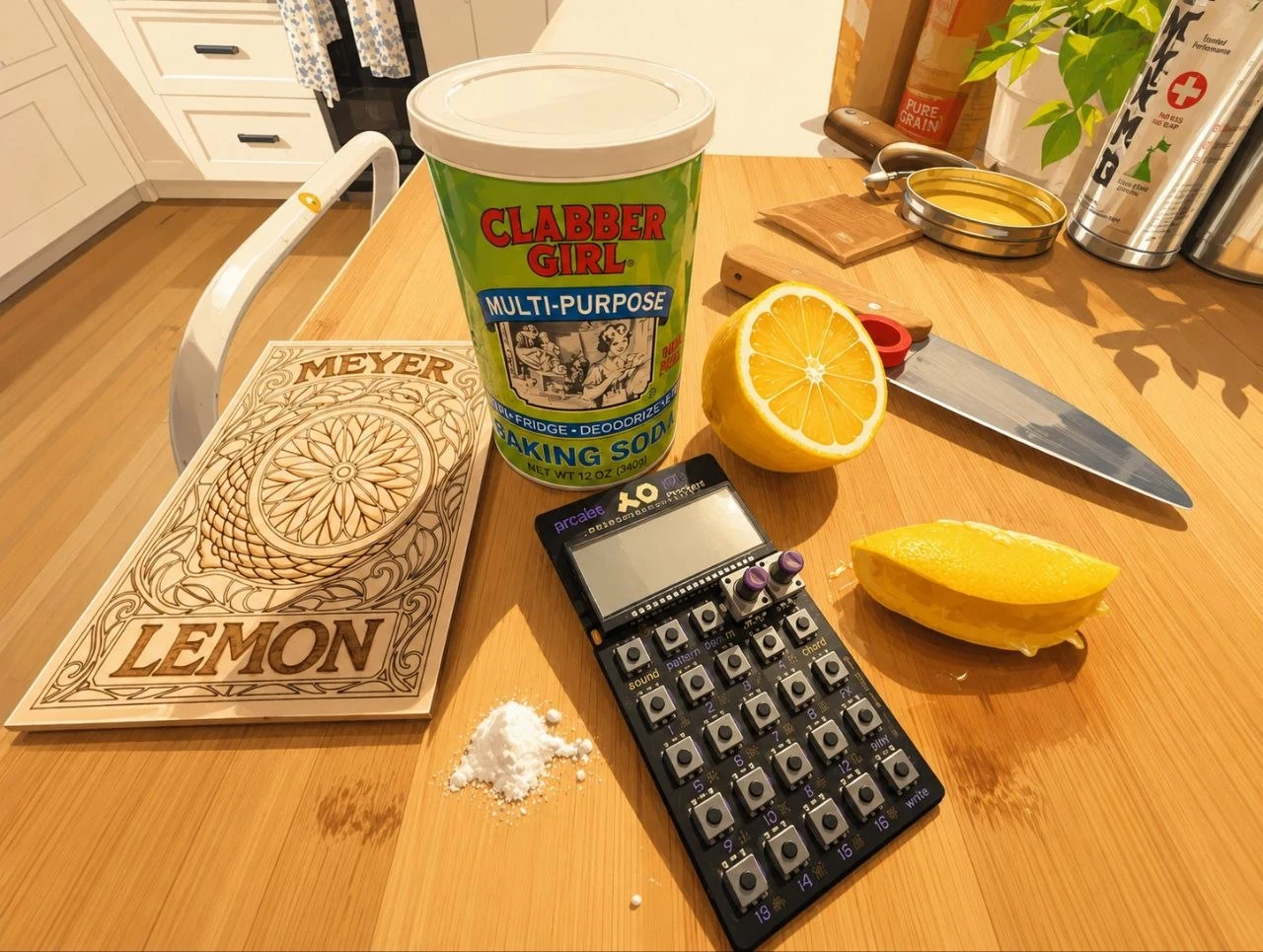
This morning at breakfast, Nico and Javier found one of Javier’s old Pocket Operators tucked away like a tiny robot from another era.
It looks a little like a calculator, with exposed circuits, buttons, a battery compartment, and an old-style LCD screen. Instead of solving math problems, it makes music. It is a small sampler and synthesizer, which means kids can press buttons, build patterns, change sounds, and make their own strange little songs.
Nico was immediately interested.
Then we opened the battery compartment.
The old batteries had corroded.
That was a very disappointing discovery. The contacts were crusty, the metal looked stained, and our little music machine seemed like it might be finished. Instead of tossing it aside, we turned it into a breakfast-table science rescue.
Javier had a conversation with our home AI, and together they explained to Nico that lemon juice and baking soda can sometimes help clean old battery corrosion. We gathered cotton swabs, a little water, lemon juice, baking soda, and paper towels. Then we removed the old batteries and started very carefully cleaning the exposed contacts.
A grown-up note: this is an adult-supervised project. Old battery residue can irritate skin and eyes, and electronics should be dry before new batteries go anywhere near them.
What was that crusty stuff?
Most small household batteries like AA or AAA alkaline batteries do not usually leak “battery acid.” They are alkaline, which means the leak is often a basic chemical, commonly potassium hydroxide. Once it gets out into the air, it can react with carbon dioxide and turn into potassium carbonate, a white crusty material.
That crust can block the electrical connection between the battery and the metal contacts. No clean connection, no power. No power, no robot music friend.
There can also be reactions with the metal parts inside the battery compartment. Many electrical contacts include copper or copper alloys. When copper is exposed to oxygen, moisture, and other chemicals over time, it can oxidize and form green or blue-green compounds on the surface.
That color is related to the same family of changes we see on the Statue of Liberty.
The Statue of Liberty is made of copper. When it was new, it was a shiny brownish copper color. Over time, the copper reacted with air, water, carbon dioxide, sulfur compounds, and salts. Those reactions formed a thin green patina made of copper compounds, including copper carbonate, copper sulfate, and copper chloride minerals. That green layer is why the statue looks the way it does today.
On a statue, patina can be protective and beautiful.
Inside a tiny music machine, corrosion is not so helpful. It gets in the way of electricity.
Why lemon juice and baking soda?
Lemon juice contains citric acid. Since alkaline battery residue is basic, a small amount of acid can help neutralize and loosen it. Baking soda is sodium bicarbonate. It is gentle, mildly abrasive when made into a paste, and useful in many home cleaning experiments. When acids and baking soda meet, they can fizz because carbon dioxide gas is released.
For Nico, the fizz was part of the magic.
For the Pocket Operator, the important part was patience: tiny amounts, cotton swabs, careful scrubbing, and time to dry.
We cleaned the contacts, wiped away residue, used a little water on a fresh swab, and let everything dry completely. Then came the real test.
New batteries.
A button press.
And then the sound came back.
The return of the robot music friend
Nico was delighted. The tiny screen woke up. The buttons worked. The Pocket Operator started making its beeps and patterns again.
It felt like a rescue mission.
Nico felt like he saved the day, and in a real way, he did. He helped observe the problem, ask questions, try a careful experiment, and bring an old object back into use.
That is one of our favorite kinds of learning: the kind that happens because something real needs care.
A broken battery compartment became chemistry.
A little corrosion became a conversation about copper and the Statue of Liberty.
An old music toy became a lesson in repair.
And our little robot music friend came back to life.