
At a recent Alpha School event, I expected to hear a great deal about artificial intelligence. I left thinking mostly about people.
Alpha’s deeper innovation is not simply better technology. Personalized tools can help children master conventional academics at their own pace. The adult’s role shifts toward motivation, relationships, meaningful standards, and helping children recognize their growth.
That leads to the more interesting question:
What should children do with the time intelligence gives back to them?
Reclaimed time needs a purpose
“Two-hour learning” can sound like a faster school day. The fuller promise is reclaimed time with intentionality attached to it.
Children gain room for teamwork, courage, creative work, entrepreneurship, and exploration. Technology creates capacity. The human community decides what that capacity is for.
One story described a teenager whose curiosity about relationships grew into research, an AI-assisted advice tool, and a test of whether her work was useful.
The important adult move was not assigning a more respectable interest. It was saying, in effect:
Your curiosity is valuable. Now investigate it, build something, test it, and learn what responsibility comes with sharing it.
A garden is a living-world mastery environment
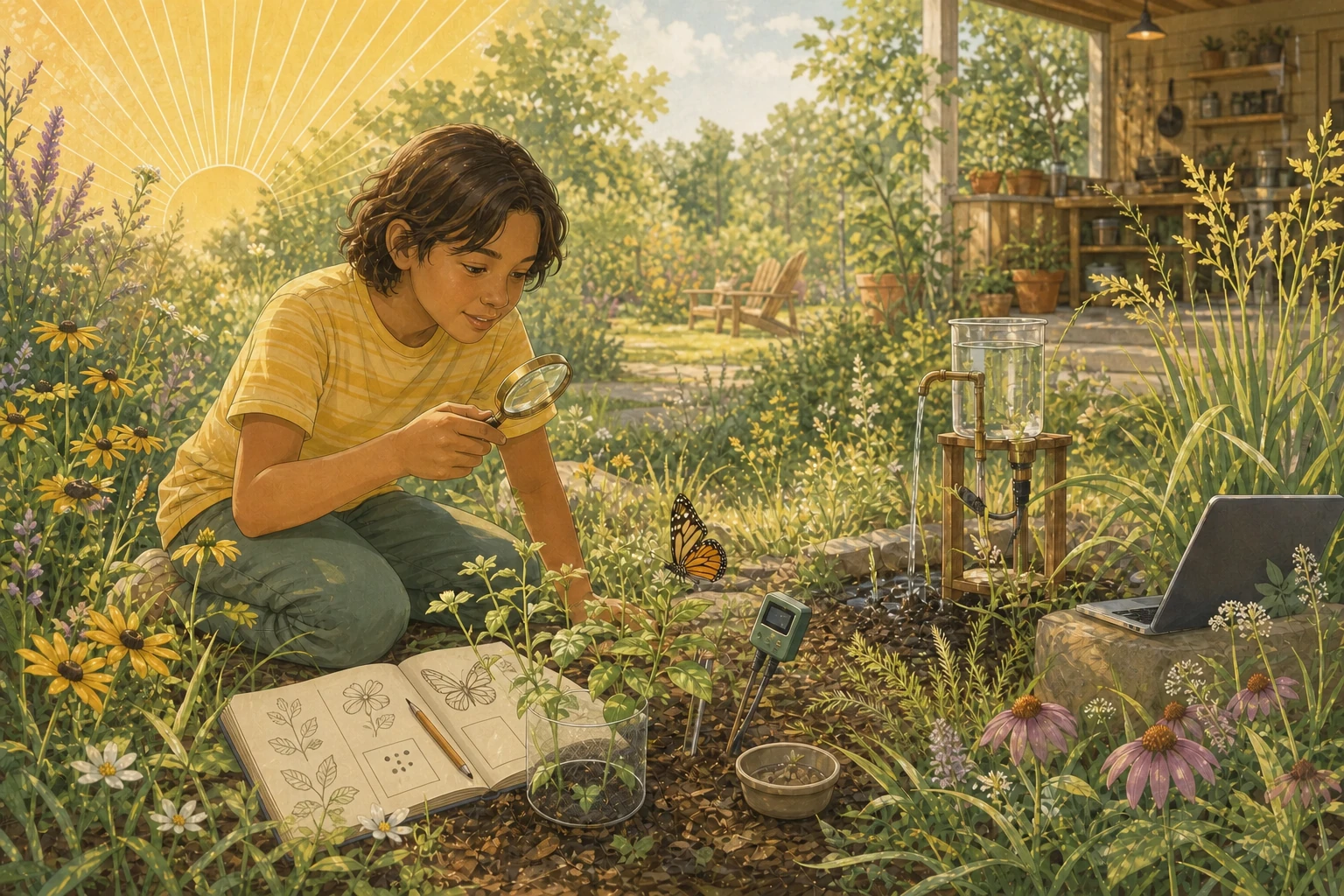
This connects strongly with the Garden Lab we have been imagining at Meyer Lemon.
A garden gives honest feedback. A seed germinates or it does not. Irrigation reaches the bed or it does not. Soil dries out. A caterpillar eats the plant. Weather changes the plan. Children have to observe, investigate, intervene, measure, adapt, and try again.
One child may wonder why butterflies gather in a prairie planting. Another may test soil, make hot sauce, build irrigation, or help a neighbor choose plants.
These do not all need to become predetermined lessons. They can become quests:
Notice → wonder → investigate → intervene → observe → adapt → build → communicate → contribute → reflect
The result is not just knowledge. It is evidence that a child can meet real conditions with curiosity, judgment, and care.
The adult remains a guide
Self-direction does not mean leaving children alone with powerful tools or ecological consequences. Adults hold safety and ethical boundaries, ask better questions, and help children distinguish observation from assumption.
AI can organize evidence or compare ideas, but it should not replace the child’s encounter, judgment, voice, or responsibility. The child should still be able to explain what they noticed, what failed, what help they received, and what they will change next.
Not everything should be optimized
AI-enabled academics are powerful when the destination is known. Nature contributes something different: unplanned phenomena, incomplete information, delayed feedback, and discoveries no one placed in the lesson plan.
Structured mastery can help children learn what we already know they should learn. Living systems can give them freedom to discover what no one knew they were going to learn.
The larger measure is thriving.
Intelligence can create capacity. Capacity can create time. Time can create meaningful choices. Those choices can build agency—and agency directed toward care and contribution can support human and ecological thriving.
Alpha gives children time back from school and asks what they can become with it.
A Garden Lab can give them a living world in which to find out.
A note on context
This reflection grew from ideas Javier heard at a recent Alpha School event and from Meyer Lemon’s developing Garden Lab thinking. It represents Javier’s interpretation, not an announcement of an Alpha–Meyer Lemon partnership.