Drafts by Sol

Blog drafts for Ashley review

Three draft posts based on the Meyer Lemon curriculum wiki. These are not linked from the main site navigation.

· October 11, 2025

Kokedama, Cub Scouts, and a Lesson in Precious Water
Draft hero image

File: 2025-10-11-cub-scout-kokedama-water-resourcefulness.md

Reviewer:

# Kokedama, Cub Scouts, and a Lesson in Precious Water

Sebastian is part of our local Cub Scout troop, and Ashley has been building hands-on garden and nature learning through Meyer Lemon. She loves creating activities where children can work with living materials, ask questions, and practice care in a real way.

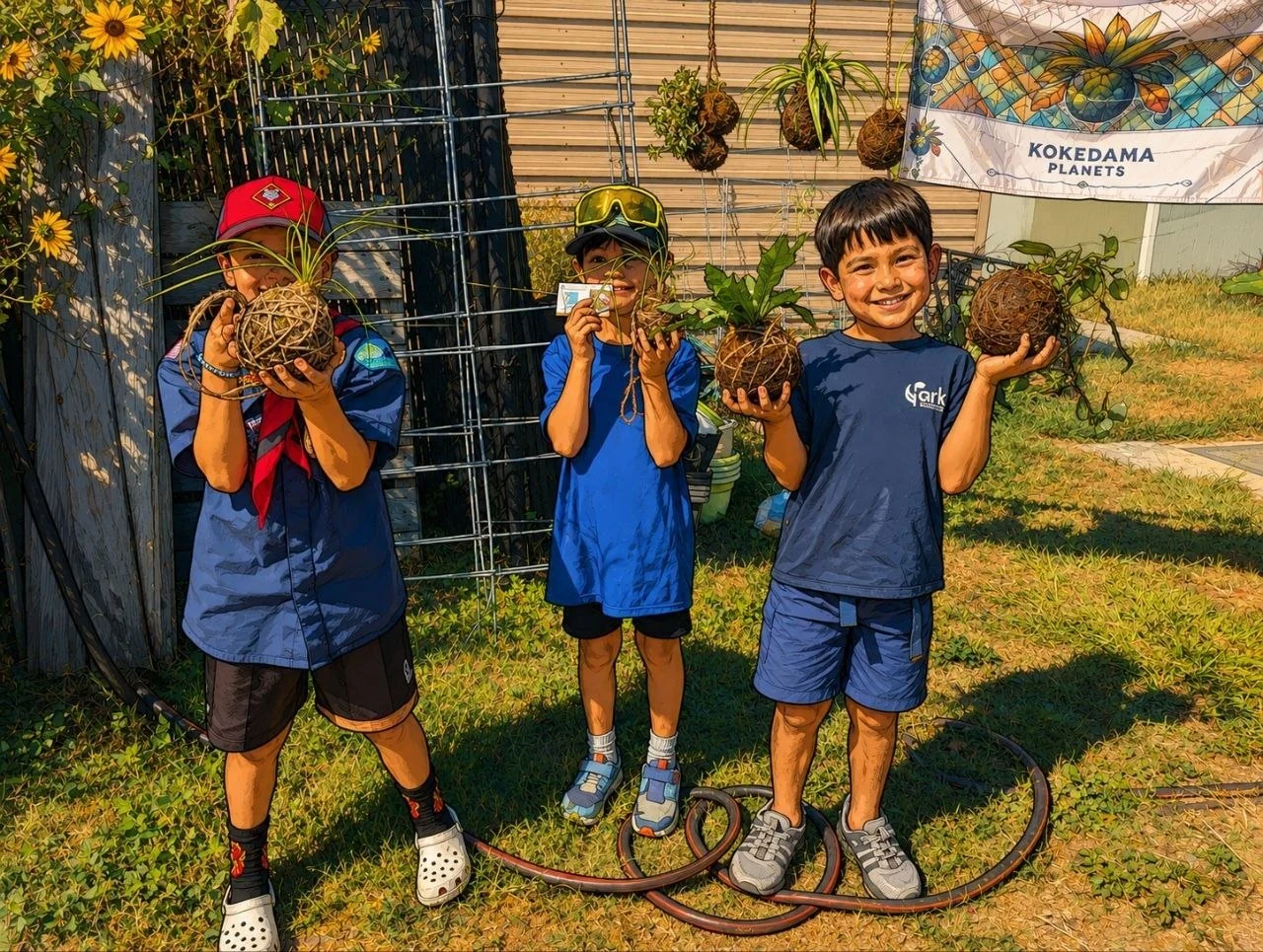
This fall, Sebastian and Ashley brought that approach to his fellow Cub Scouts by hosting a kokedama workshop as part of their sustainability badge work.

Kokedama are moss balls that hold and care for a plant using simple natural materials. Instead of a plastic pot, the roots are wrapped in soil, moss, and string. They are beautiful, but they are also a good teaching object: you can hold one in your hands and talk about soil, roots, water, air, plant care, and the materials we choose to use.

Talking about natural resources

Before everyone started building, we talked about natural resources and what it means to conserve them. The scouts were working with living plants, moss, string, soil, and water. Every part of the project invited a question:

What do plants need?

Where do those materials come from?

How can we care for something without wasting what it needs?

Why does water matter so much, especially in a garden?

That last question became very real very quickly.

When we went to use the garden hose, we realized it was completely shut off. No running water.

Suddenly the conversation about conserving resources was not just a badge topic. It was the actual problem in front of us.

The water rescue team

The group rallied.

Some friends brought a cooler full of water from a nearby neighbor. Sebastian and Javier went back home to get a large jug of water. Since it was a warm day and everyone was working hard, they also brought back fresh popsicles for the scouts.

It was such a simple thing, but it changed the energy of the whole workshop. The kids could see that water was not just something that appears when you turn a handle. It had to be found, carried, shared, and used thoughtfully.

That is a powerful lesson.

Sometimes sustainability sounds like a big adult word. In that moment it looked like families helping each other, scouts carrying supplies, kids waiting patiently, and everyone understanding that one cooler and one jug of water mattered.

Making something living with your hands

Once the water was sorted, the workshop became joyful and messy in the best way.

The scouts shaped their soil, wrapped moss, tied string, tucked in plants, asked questions, compared designs, and helped each other. Families worked side by side. Every kokedama came out a little different, which is part of the charm.

Some were neat and round.

Some had wild strings.

Some looked like tiny planets with plants growing out of them.

All of them were made by hand.

And because the kids had just experienced the water problem together, caring for the finished kokedama felt more meaningful. These little moss balls were not decorations. They were living things that needed attention, water, and care.

What stayed with us

One of the nicest parts has been seeing those kokedama again later, when we visit friends for birthdays and house parties. A project that started at a scout workshop kept living in people’s homes.

That is the kind of learning we love.

A badge requirement became a community garden day.

A craft became a conversation about resources.

A broken hose became a real lesson in conservation.

And a group of scouts got to leave with something living that they made with their own hands.

· March 25, 2026

Bringing a Pocket Operator Back to Life with Lemon Science

Draft hero image

File: 2026-03-25-pocket-operator-lemon-science.md

Reviewer:

# Bringing a Pocket Operator Back to Life with Lemon Science

This morning at breakfast, Nico and Javier found one of Javier’s old Pocket Operators tucked away like a tiny robot from another era.

It looks a little like a calculator, with exposed circuits, buttons, a battery compartment, and an old-style LCD screen. Instead of solving math problems, it makes music. It is a small sampler and synthesizer, which means kids can press buttons, build patterns, change sounds, and make their own strange little songs.

Nico was immediately interested.

Then we opened the battery compartment.

The old batteries had corroded.

That was a very disappointing discovery. The contacts were crusty, the metal looked stained, and our little music machine seemed like it might be finished. Instead of tossing it aside, we turned it into a breakfast-table science rescue.

Javier had a conversation with our home AI, and together they explained to Nico that lemon juice and baking soda can sometimes help clean old battery corrosion. We gathered cotton swabs, a little water, lemon juice, baking soda, and paper towels. Then we removed the old batteries and started very carefully cleaning the exposed contacts.

A grown-up note: this is an adult-supervised project. Old battery residue can irritate skin and eyes, and electronics should be dry before new batteries go anywhere near them.

What was that crusty stuff?

Most small household batteries like AA or AAA alkaline batteries do not usually leak “battery acid.” They are alkaline, which means the leak is often a basic chemical, commonly potassium hydroxide. Once it gets out into the air, it can react with carbon dioxide and turn into potassium carbonate, a white crusty material.

That crust can block the electrical connection between the battery and the metal contacts. No clean connection, no power. No power, no robot music friend.

There can also be reactions with the metal parts inside the battery compartment. Many electrical contacts include copper or copper alloys. When copper is exposed to oxygen, moisture, and other chemicals over time, it can oxidize and form green or blue-green compounds on the surface.

That color is related to the same family of changes we see on the Statue of Liberty.

The Statue of Liberty is made of copper. When it was new, it was a shiny brownish copper color. Over time, the copper reacted with air, water, carbon dioxide, sulfur compounds, and salts. Those reactions formed a thin green patina made of copper compounds, including copper carbonate, copper sulfate, and copper chloride minerals. That green layer is why the statue looks the way it does today.

On a statue, patina can be protective and beautiful.

Inside a tiny music machine, corrosion is not so helpful. It gets in the way of electricity.

Why lemon juice and baking soda?

Lemon juice contains citric acid. Since alkaline battery residue is basic, a small amount of acid can help neutralize and loosen it. Baking soda is sodium bicarbonate. It is gentle, mildly abrasive when made into a paste, and useful in many home cleaning experiments. When acids and baking soda meet, they can fizz because carbon dioxide gas is released.

For Nico, the fizz was part of the magic.

For the Pocket Operator, the important part was patience: tiny amounts, cotton swabs, careful scrubbing, and time to dry.

We cleaned the contacts, wiped away residue, used a little water on a fresh swab, and let everything dry completely. Then came the real test.

New batteries.

A button press.

And then the sound came back.

The return of the robot music friend

Nico was delighted. The tiny screen woke up. The buttons worked. The Pocket Operator started making its beeps and patterns again.

It felt like a rescue mission.

Nico felt like he saved the day, and in a real way, he did. He helped observe the problem, ask questions, try a careful experiment, and bring an old object back into use.

That is one of our favorite kinds of learning: the kind that happens because something real needs care.

A broken battery compartment became chemistry.

A little corrosion became a conversation about copper and the Statue of Liberty.

An old music toy became a lesson in repair.

And our little robot music friend came back to life.

draft · 2026-05-06

Girl Scout Kokedama Quest

Draft hero image

File: 2026-05-06-girl-scout-kokedama-workshop.md

Reviewer:

# Girl Scout Kokedama Quest

We recently hosted a kokedama workshop for a local Girl Scout troop, and it was exactly the kind of afternoon Meyer Lemon loves: plants on the table, soil everywhere, a little uncertainty at first, and a lot of pride by the end.

We met under a shaded pavilion with plants, soil, moss, twine, and a simple reference guide so the girls could follow each step at their own pace.

Kokedama is a Japanese planting method where the plant's roots are wrapped in soil and moss, then tied into a ball. It is part plant care, part sculpture, and part patience practice. There is no way to make one without using your hands.

That was the interesting part.

At the beginning, several girls were hesitant. The soil was damp. The moss was loose. The roots needed to be handled gently but directly. A few girls were not sure they wanted to dig in, and honestly, that made complete sense. Many children spend a lot of their day being told to stay clean, keep things contained, and avoid making a mess.

Garden work asks for something different.

It asks us to tolerate messy hands long enough to learn what the plant needs. It asks us to notice texture, moisture, roots, leaves, and weight. It asks us to stay with a process even when it feels unfamiliar. That is a real skill, and it does not always come naturally at first.

As the workshop went on, the hesitation started to shift. The girls pressed soil around roots. They wrapped moss. They held the plant steady while looping twine around and around. Some needed help getting started. Some needed help tying the final knots. Each kokedama slowly became something they could recognize as their own.

By the end, the feeling had changed completely. The girls were proud of what they made. They held up their plants for a group photo, each kokedama different from the next. Some were neat and round. Some were a little wild. All of them were alive, handmade, and ready to go home.

A few parents and girls even sounded like they might try making kokedama again. That may be my favorite kind of workshop outcome. Not perfection. Not everyone doing the same thing. Just enough confidence to think, "I could do this again."

That is a big part of what Meyer Lemon is trying to offer families: hands-on experiences that make nature feel close, possible, and worth paying attention to. Sometimes that starts with a native plant. Sometimes with a mushroom block, a seed jar, a compost bin, or a backyard habitat. And sometimes it starts with a group of Girl Scouts learning that muddy fingers are not a problem to avoid. They are part of the work.

The reference guide helped the troop move through the steps, but the real learning happened in the doing. They practiced care, patience, observation, and a little bit of bravery. They left with a living plant they had shaped themselves.

That is a pretty good afternoon.

Take-home kokedama guide

At the end of the workshop, each girl had a simple reference guide to help her remember what she made and how to care for it at home.

The guide walks through the basic steps: building the soil ball, wrapping it with moss, tying it together, and making it personal. It also gives the girls a place to name their plant and make a small plant-care promise.

I like that part because the worksheet turns the kokedama from a one-time craft into something they are responsible for. Take care of it. Notice when it feels light or dry. Give it water. Find a soft sunny spot. Check on it every few days.

That is the real follow-through. The workshop ends, but the relationship with the plant keeps going.

Photo note

The workshop photo shows the troop gathered together under the pavilion, each girl holding her finished kokedama up in front of her face. The plants become the portrait: leaves, moss, twine, and proud hands.

draft-by-sol · 2026-05-09

The Bug Hotel Check-In: Turning a Backyard Corner into a Tiny Neighborhood

Draft hero image

File: 2026-05-09-bug-hotel-check-in.md

Reviewer: Ashley

# The Bug Hotel Check-In: Turning a Backyard Corner into a Tiny Neighborhood

There is a special kind of quiet that happens when a child realizes the backyard is already full of neighbors.

Not pretend neighbors. Real ones. Tiny ones. The kind with wings, antennae, segmented legs, and extremely specific housing preferences.

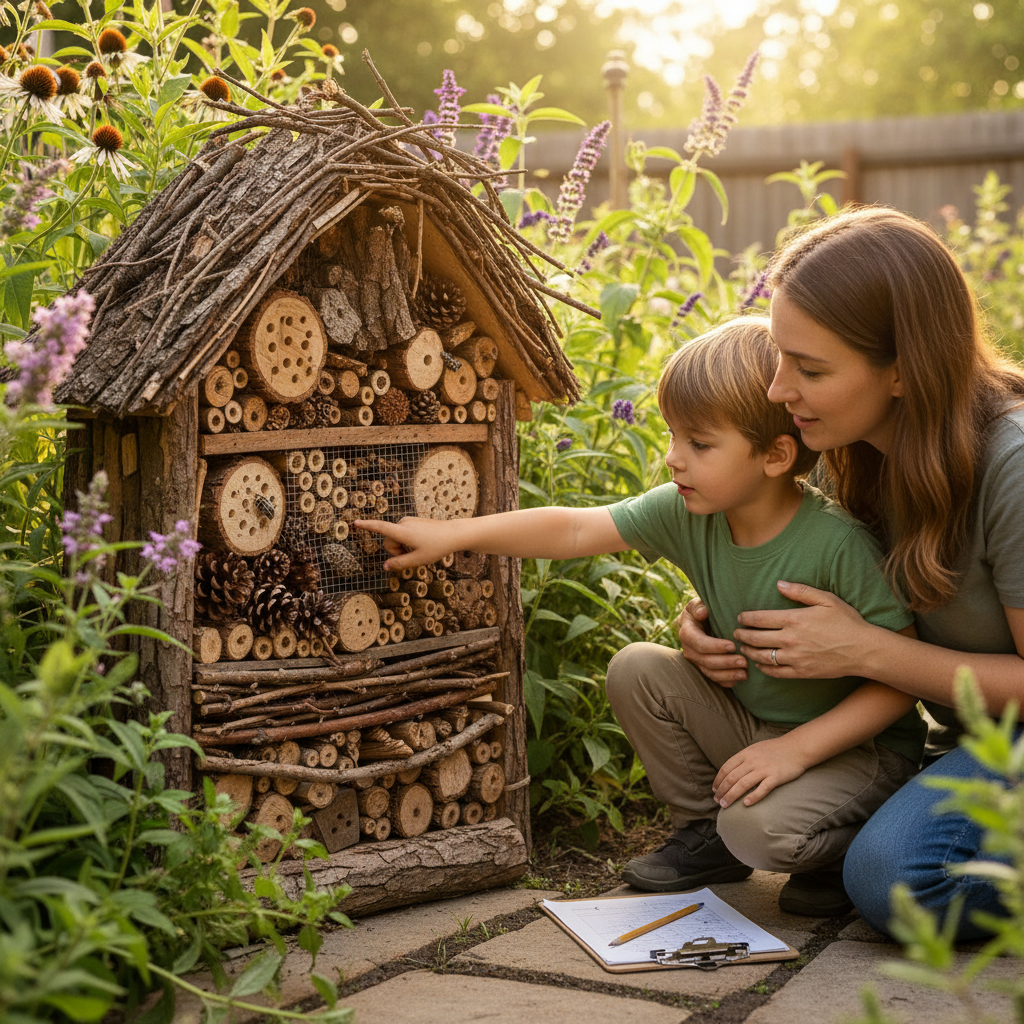
A bug hotel seems simple at first: sticks, bark, pinecones, hollow stems, maybe a few drilled blocks of wood tucked into a frame. The moment we place it outside, it stops being a craft and becomes a question.

Who will come?

What kind of home did we actually make?

And what does our yard need to offer so those visitors are not just stopping by, but actually supported?

Building the hotel is only the beginning

The fun part is collecting materials. Kids are excellent at this because they notice textures adults walk past.

A curled piece of bark. A hollow stem. A pinecone that looks like a tiny apartment building. A bundle of twigs that feels messy to us, but might look like shelter to something smaller.

When children help choose the materials, they are not just decorating. They are designing for another creature's body.

A solitary bee may need a narrow tunnel.

A beetle may prefer a darker crack.

A spider might choose the corner nobody thought was important.

That is the first lesson: habitat is not generic. A home is always a home for someone.

The first arrivals

After the hotel is built, the real activity becomes observation.

Bring a clipboard outside once a week and ask:

What changed?

Which spaces are still empty?

Do we see webs, leaves, mud caps, chew marks, or tiny movements?

What weather happened this week?

Which part of the hotel seems most interesting to the insects?

The goal is not to identify every species perfectly. The goal is to practice attention. A child who notices that one hollow reed is sealed with mud has already started thinking like an ecologist.

Something chose that space.

Something changed the structure.

Something is happening here.

Messy is not the same as neglected

One of the best conversations a bug hotel can start is about the difference between "messy" and "alive."

A perfectly clean garden may look tidy, but it often removes the very materials small creatures need: leaf litter, old stems, bark, soft soil, shady corners, and places to hide.

This does not mean the whole yard has to become chaos. It means we can make room for little pockets of complexity.

A corner can be allowed to hold leaves.

A few stems can stay standing through winter.

A small pile of sticks can become a habitat instead of a chore.

For kids, this is powerful. They learn that care does not always look like cleaning up. Sometimes care looks like leaving the right thing alone.

Try it at home: the weekly bug hotel check-in

You will need:

  • A small bug hotel or a bundle of natural materials
  • A clipboard or notebook
  • A pencil
  • Optional: magnifying glass
  • Optional: a simple map of the yard

Each week, invite your child to record three things:

  1. One thing they see
  2. One thing that changed
  3. One question they have

Their notes might be simple:

"The left tube is closed."

"There are ants near the bottom."

"Why do they like the shady side?"

That is enough. Those small observations are the beginning of long-term ecological thinking.

Final thought

A bug hotel teaches a child that design has consequences.

If we build only for ourselves, the yard becomes a decoration. If we build with other lives in mind, the yard becomes a relationship.

And sometimes the smallest neighbors are the best teachers.

draft-for-ashley-review · 2026-02-15

The Kokedama Weigh-In: Learning to Care by Touch

Draft hero image

File: 2026-05-09-kokedama-weigh-in.md

Reviewer: Ashley

# The Kokedama Weigh-In: Learning to Care by Touch

At first, it feels like a craft. You gather the materials, shape the soil, wrap the moss, tie the string, and suddenly there is this little living sculpture sitting in front of you. It is beautiful and satisfying in the way a finished craft is satisfying.

Then the next day comes.

The moss feels a little different. The ball is not quite as heavy. The plant may be leaning toward the light. A few days later, the whole thing feels lighter in your hand, and now the project is asking for something.

That is where the real learning begins.

A plant you can hold

Kokedama gives kids a very simple way to notice plant care with their bodies. Instead of starting with a rule like “water every few days,” they can begin by picking it up.

Is it heavy or light?

Cool or warm?

Damp or dry?

Soft, springy, crumbly, or crisp around the edges?

Those small observations matter. They help children build a relationship with the plant instead of just following instructions. The kokedama becomes something they check in on, not something they made once and forgot.

For younger kids especially, touch can come before explanation. They may not understand evaporation, humidity, drainage, or root uptake yet, but they can absolutely feel the difference between “full of water” and “ready for a soak.”

Try a kokedama weigh-in

This is a simple activity we can use after making a kokedama, or anytime a family is learning how to care for one.

You will need:

  • A kokedama
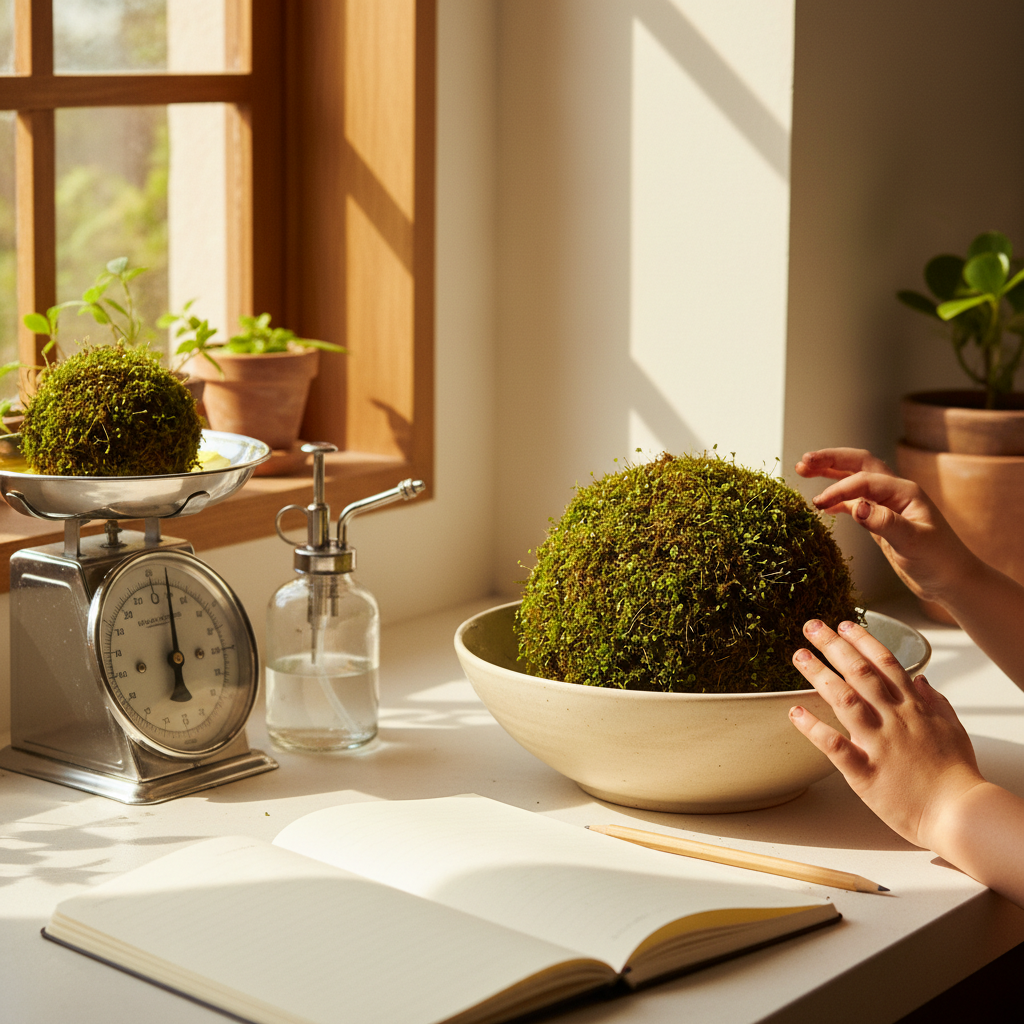
  • A kitchen scale
  • A shallow bowl of water
  • A notebook or piece of paper
  • A pencil

Start before watering. Invite your child to hold the kokedama and describe what they notice. No need to correct them or give them the “right” words right away. If they say it feels fluffy, hard, cold, tired, heavy, or weird, write that down.

Then place it on the scale and record the weight.

Next, soak the kokedama in a bowl of water until it has had time to drink. Let it drain for a few minutes, then weigh it again.

Ask:

  • What changed?
  • How much heavier is it now?
  • Does the number match what your hands noticed?
  • How many days does it take before it feels light again?

You can repeat the same check-in over several days. The goal is not to turn plant care into homework. The goal is to help kids notice patterns.

Care as a practice

I like this activity because it makes care concrete.

Sometimes we talk about responsibility with kids in a way that feels abstract: be responsible, take care of your things, remember to water the plant. A kokedama gives them feedback they can feel. It lets them practice paying attention.

The plant does not need perfection. It needs noticing.

That is a gentle but important lesson. A child can learn that care is not just one big action. It is a rhythm: check, notice, adjust, return.

And if the kokedama gets too dry? That is not a failure. It is information. What did we notice? What can we try next time? Where might it like to live in the house? Does this room get too much sun? Not enough? Is the air very dry?

These are the beginnings of scientific thinking, but they also feel very human.

What kokedama can teach

A kokedama workshop can include art, plant science, sensory play, fine motor work, and a little bit of patience. The part I love most is the relationship that continues afterward.

The moss holds moisture.

The soil protects the roots.

The string supports the shape.

The plant keeps responding to light, water, and time.

Children can see that each material has a role. They can also see that living things are not props. They have needs, preferences, and signals.

That is a lot for one small moss ball to teach.

A simple family rhythm

If you make a kokedama at home, try choosing one check-in day each week. Maybe Sunday morning. Maybe after school on Fridays. Let your child be the one to pick it up first and make a prediction before watering.

You might keep a tiny care chart with three columns:

  • Date
  • How it felt
  • What we did

That is enough.

Over time, the child starts to know the plant in a real way. Not because someone gave them a rule, but because they have been paying attention.

Final thought

A kokedama is small enough for a child to hold, but rich enough to teach patience, observation, and care.

It reminds us that learning does not always have to start with a worksheet or a lecture. Sometimes it starts with a child holding a moss ball in their hands and saying, “I think it feels lighter today.”

That is a beautiful beginning.

draft-by-sol · 2026-05-09

The Lemon Peel Time Machine: A Kitchen Compost Jar for Curious Kids

Draft hero image

File: 2026-05-09-lemon-peel-compost-jar.md

Reviewer: Ashley

# The Lemon Peel Time Machine: A Kitchen Compost Jar for Curious Kids

A lemon peel does not disappear when we throw it away.

It goes somewhere.

That sounds obvious, but for kids it can be a surprisingly powerful idea. The end of snack time, lemonade making, or zesting a Meyer lemon is not really an ending. It is the beginning of another process: drying, softening, darkening, feeding, changing.

A compost jar makes that hidden story visible.

It turns the kitchen into a laboratory and the leftover peel into a time machine.

What happens after the lemon?

Meyer lemons are bright, fragrant, and easy to love when they are fresh. The peel is full of oils. The juice is sharp and sweet. The smell fills the room before anyone has tasted anything.

The compost question is different:

What happens when the beautiful part is over?

Where does the peel go next?

Who can use it?

What does it become?

This is where decomposition becomes less like "trash" and more like transformation.

Build a window compost jar

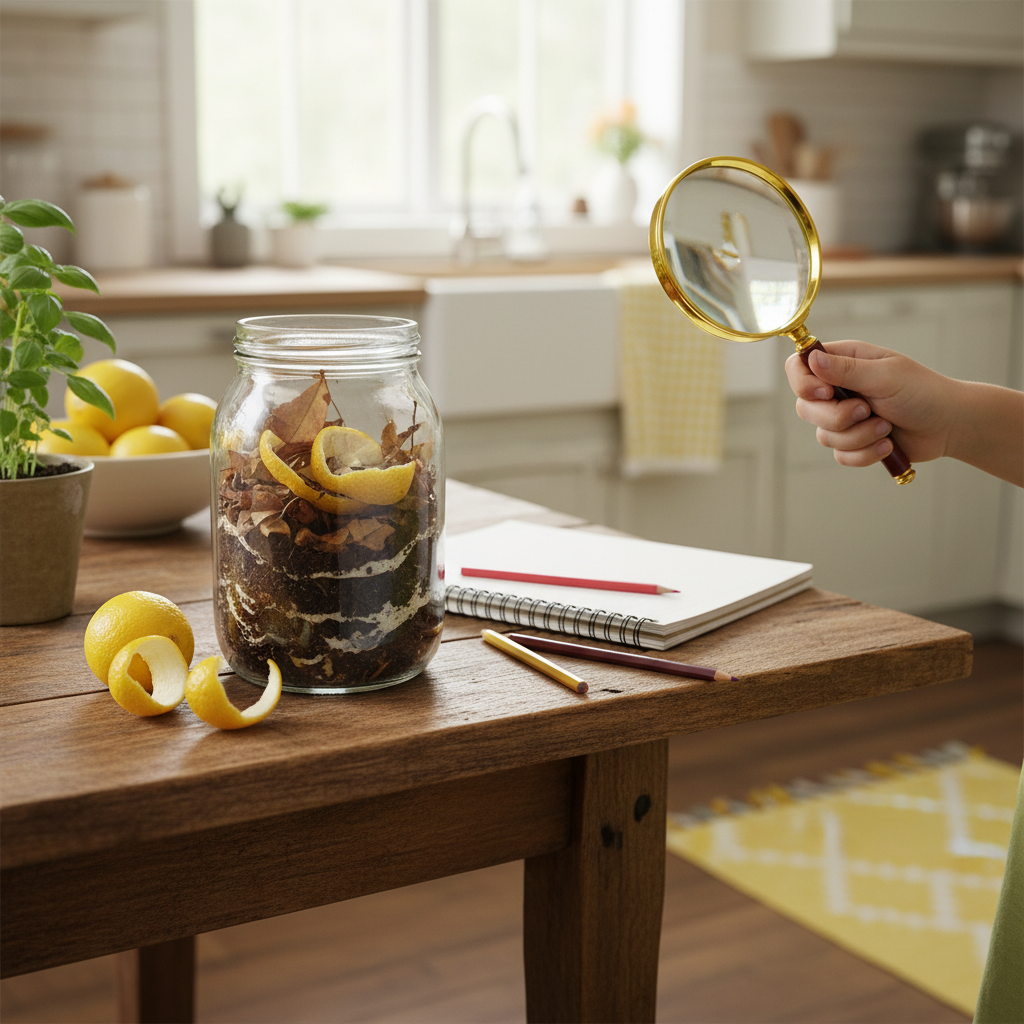
This is not a full compost system. It is an observation tool.

You will need:

  • A clear jar
  • A small handful of soil
  • Dry leaves or shredded paper
  • A few small fruit or vegetable scraps
  • A small piece of Meyer lemon peel
  • A spray bottle
  • A notebook
  • Optional: magnifying glass

Layer the jar like a tiny landscape:

Soil.

Leaves.

A little peel.

More dry material.

A mist of water.

Then place it somewhere visible but not in direct hot sun.

The goal is not to make perfect compost quickly. The goal is to watch change happen.

What to observe

Each day or every few days, invite your child to check the jar.

Ask:

What color changed?

What got softer?

What stayed the same?

Is there condensation on the glass?

Does the jar smell earthy, sour, dry, or too wet?

Do you see tiny tunnels, clumps, threads, or fuzzy spots?

If something smells bad, that is not failure. It is information. The system may be too wet, too compacted, or not getting enough air. That is a chance to talk about balance.

Compost is not magic. It is a living process with preferences.

The hidden helpers

A compost jar gives children a doorway into the invisible workforce beneath a garden.

Bacteria begin breaking things down.

Fungi thread through the material.

Tiny invertebrates, if present, help shred and mix.

Moisture changes what can happen.

Air changes what can happen.

Time changes everything.

Suddenly the peel is not waste. It is food for a community we usually do not see.

From kitchen to garden

This is the systems lesson hiding in the jar:

The kitchen feeds the compost.

The compost feeds the soil.

The soil feeds the plant.

The plant feeds the family.

Then the scraps return to the cycle.

For a child, that loop is easier to understand when they can point to each part. The peel in the jar is not abstract. It is evidence.

Final thought

A lemon peel can teach more than flavor.

It can teach patience, change, smell, moisture, balance, and the idea that nothing in a living system is truly separate.

Sometimes the best science lesson starts after the snack is over.

draft-by-sol · 2026-05-16

Before You Buy Native Plants, Watch Your Yard for a Week

Draft hero image

File: 2026-05-16-before-you-buy-native-plants.md

Reviewer: Ashley

# Before You Buy Native Plants, Watch Your Yard for a Week

It is very easy to fall in love with a plant at a nursery.

A flower is blooming. The tag says butterflies love it. The leaves look healthy. You can already picture it in the yard.

I get it.

One of the kindest things we can do before bringing home native plants is to slow down and watch the place they are going to live.

Not forever. Just a week.

A yard has opinions. It has hot spots, damp corners, compacted paths, shady pockets, bird perches, forgotten edges, and places where children naturally gather. If we pay attention first, the garden starts telling us what kind of care belongs there.

Native plants are about relationships

Native plants are often described as low maintenance or good for pollinators, and both can be true. I think the more meaningful way to explain them to children is this:

A native plant already knows a place.

It has relationships with local soil, rainfall, heat, insects, birds, and seasons. A plant that belongs here is not standing alone. It is part of a web.

That is why a native garden can become such a good family learning space. It is not just pretty. It gives children something real to observe:

  • Who visits this flower?
  • What eats these leaves?
  • Where do birds land?
  • What changes after rain?
  • Which plant looks happier in shade?
  • Which insects show up when something blooms?

Those questions are the beginning of ecological thinking. They also make the yard feel less like a project to finish and more like a relationship to keep learning.

Start with a one-week yard watch

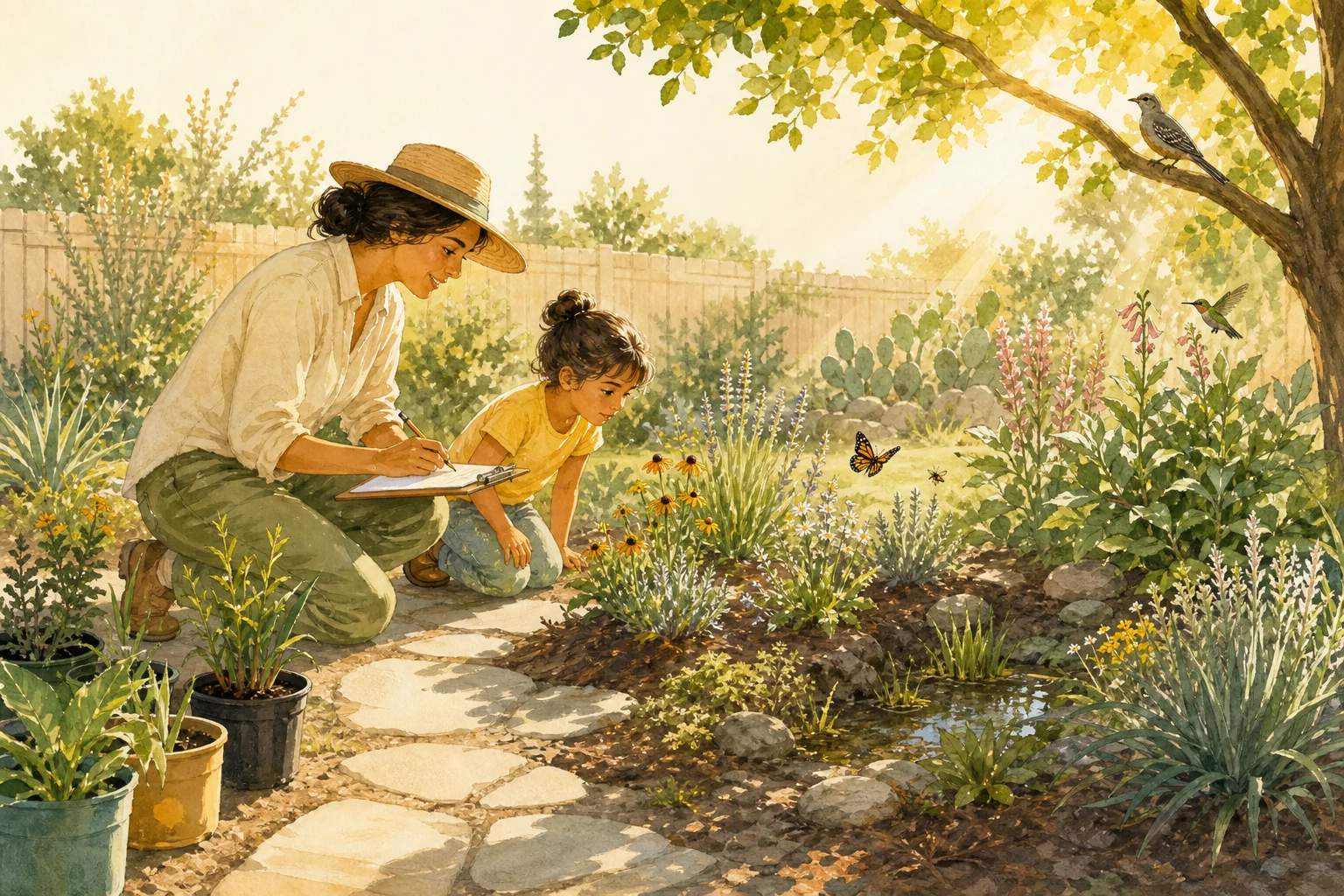
Before you choose plants, try watching your yard or school garden for one week.

You do not need special tools. A notebook, pencil, and a few minutes outside are enough.

Each day, notice one thing:

Day 1: Light
Where does morning sun land first? What feels hottest in the afternoon? What stays shaded most of the day?

Day 2: Water
After rain or watering, where does water collect? What dries out quickly? Is there a muddy path or a low spot?

Day 3: Soil
Where is the soil loose? Where is it hard or compacted? Are there roots, mulch, leaf litter, sand, clay, or bare patches?

Day 4: Wildlife
Where do birds land? What insects visit flowers? Do you see ants, bees, butterflies, beetles, lizards, or signs that something has been nibbling?

Day 5: Movement
Where do people naturally walk? Where do kids sit, dig, run, hide, or avoid? A garden works better when it respects how a family already moves.

Day 6: Favorite places
Where do you feel calm? Where do you want to sit? What corner feels alive? What area feels forgotten?

Day 7: One small idea
Choose one place that seems ready for care. Not the whole yard. One patch.

Let children become the observers

Kids are good at this when we give them permission to be specific.

They may notice the tiny red insect on a stem before they notice the “overall design.” They may care more about the muddy place where their shoes get stuck than the bed we thought looked most important. They may name a plant by what visits it: the bee flower, the bird bush, the fuzzy leaf plant.

That is not a distraction. That is the learning.

A child who notices that butterflies keep returning to one flower is already studying plant relationships. A child who sees that a shady corner stays damp longer is already thinking about microclimates. A child who asks why something ate the leaves is ready for a conversation about host plants.

We do not have to rush to the vocabulary. The attention can come first.

Choose plants for the place, not the picture

After a week of watching, plant choices get easier.

A hot, sunny, dry patch asks for different plants than a shady corner under a tree. A wet spot after rain may be an invitation, not a problem. A path where children always run may need to stay open instead of being planted over.

This is where native gardening becomes less about decorating and more about listening.

Ask:

  • Is this spot sunny, partly sunny, or shaded?
  • Does it stay dry or hold water?
  • What kind of wildlife do we want to support?
  • How much space will the plant need when it is grown?
  • Can we care for this while it gets established?
  • What should stay exactly as it is?

That last question matters. Sometimes the best garden decision is not adding anything. Sometimes it is leaving the leaves, protecting the shade, keeping the path, or noticing that a plant already doing well deserves more room.

A tiny native plant patch is enough

You do not need to convert a whole yard to begin.

Start with a 3-by-5 foot patch. Give it a clear edge so it looks intentional. Choose a few plants that match the sun and water you observed. Plant in groups rather than one of everything. Leave space for mature size, even if the plants look small at first.

Then keep watching.

What blooms first? What gets visited? What struggles? What surprises you?

The first year of a native plant garden is not a final exam. It is the beginning of a conversation.

A simple family activity

Try this before your next nursery trip.

Give each person a job:

  • Sun watcher
  • Water watcher
  • Soil checker
  • Wildlife detective
  • Path and play observer

Walk the yard together and let each person report what they noticed. Then choose one small place to improve.

You might decide to plant flowers for pollinators. You might add a shrub for birds. You might choose a sedge or groundcover for a shady patch. You might simply mark a corner as a future observation spot and wait a little longer.

Waiting counts.

In a culture that tells us to buy the solution, waiting can be a surprisingly radical garden practice.

The garden is already teaching

Native plants matter because they help us remember that a yard is not separate from the world around it.

The soil is connected to rain.

The rain is connected to roots.

The roots are connected to leaves.

The leaves are connected to insects.

The insects are connected to birds.

And the child watching all of this is connected too.

That is the part I love most. A native plant garden does not have to begin with expertise. It can begin with a family standing outside for a few minutes, paying attention together.

Observe first. Design second.

draft-by-sol · 2026-05-16

Native Plant Gardens Are Not No-Maintenance

Draft hero image

File: 2026-05-16-native-plant-gardens-are-not-no-maintenance.md

Reviewer: Ashley

# Native Plant Gardens Are Not No-Maintenance

There is a phrase I hear a lot around native plants: low maintenance.

Sometimes that is true. Native plants can be better adapted to local heat, rain, soil, insects, and seasonal stress than many ornamental plants. They often need less watering once established. They can support pollinators, birds, and soil life in ways a clipped lawn never will.

Low maintenance does not mean no maintenance.

And it definitely does not mean picture-perfect all year.

A native plant garden is alive. That is the whole point. It changes, sprawls, rests, blooms, browns, feeds, reseeds, leans, surprises you, and occasionally looks like it has made a few questionable decisions.

That does not mean you are doing it wrong.

A living garden has awkward seasons

Some plants look wonderful in spring and tired by August.

Some disappear for a while and come back when you have nearly given up on them.

Some stand brown and dry in winter, looking less like a magazine garden and more like a collection of stems you forgot to cut back.

Those winter stems may be shelter. Seed heads may be food. Leaf litter may be habitat. The quiet-looking parts of the garden can still be doing important work.

This is one of the shifts that native plant gardening asks of us. We have to learn to see value even when the garden is not performing beauty in the way we were taught to expect.

A plant can look dormant and still be useful.

A seed head can look messy and still feed a bird.

A hollow stem can look dead and still hold life.

You are allowed to shape the garden

I also think it helps to say this clearly: planting native plants does not mean you have to let everything do whatever it wants forever.

You can shape the garden.

You can trim.

You can edit.

You can cut things back in spring. You can remove plants that are taking over. You can move something that is clearly unhappy. You can create edges, paths, and structure so the garden looks intentional instead of abandoned.

That is not a betrayal of native gardening. That is stewardship.

The goal is not to freeze the garden into a perfect design. The goal is to stay in relationship with it.

Spring is often a good time for this kind of care. After winter has offered its seeds, stems, shelter, and texture, you can cut back old growth and make room for new shoots. You can see what survived, what spread, what struggled, and what needs a little help.

It is a good season to ask: What should stay? What needs space? What has earned a second chance? What has given us enough information?

First year sleep, second year creep, third year leap. Mostly.

There is an old gardening saying:

First year they sleep.
Second year they creep.
Third year they leap.

I like it because it gives people patience. A first-year native plant may be doing more underground than aboveground. Roots are finding their way. The plant is learning the site. What looks slow may actually be establishment.

The second year may bring more visible growth, but not always drama.

By the third year, many plants do start to look like themselves. They fill in. They bloom more confidently. They begin to claim space.

I would add a small, honest note from my own garden: even by the fourth year, some plants may still not be as robust as you expected.

That can be frustrating.

It can also be information.

Maybe the light is not quite right. Maybe the soil holds more water than the plant wants. Maybe the roots are competing with a nearby tree. Maybe the plant was stressed before it ever came home. Maybe the weather has been weird, because the weather is increasingly weird. Maybe that plant is simply not the one for that spot.

Native does not mean guaranteed.

It means there is a better chance of relationship if the plant, place, and care line up.

Establishment takes real care

A new native plant still needs help.

It needs watering while it settles in. It needs weed pressure managed. It may need protection from foot traffic, pets, or a child who thinks every small plant is an invitation to dig. It may need mulch, but not mulch piled against the crown. It may need patience while it builds roots instead of flowers.

This is where the “no maintenance” myth can set people up to feel like they failed.

If you plant something native and it struggles, that does not automatically mean you are bad at gardening. It means you are working with living things.

Living things have preferences.

They also have limits.

The garden is not a product photo

A lot of garden images show peak bloom. The light is perfect. The plants are full. Nothing has flopped, browned, seeded out, been eaten, or gone dormant.

That is one moment.

A real garden has many more moments than that.

There is the fresh spring moment.

The early summer bloom moment.

The late summer crispy moment.

The post-storm leaning moment.

The winter seed head moment.

The “I swear this is habitat” moment.

If children are watching, this is actually a gift. They get to see that nature is not always tidy and still has value. They learn that care is not the same as control. They learn that beauty can be seasonal, and usefulness can be quiet.

What helps a native garden look cared for

A native garden can be ecologically useful and still look intentional.

A few things help:

  • Keep a clear edge along beds or paths.
  • Plant in groups instead of one of everything scattered everywhere.
  • Leave stems or seed heads in selected areas instead of across the whole garden.
  • Use paths, stones, logs, or borders to show that the space is being tended.
  • Cut back in spring when winter habitat has had time to do its work.
  • Edit plants that crowd out others.
  • Replace what is not working without guilt.
  • Keep observing before making big changes.

The point is not perfection. The point is legibility. A garden can be a little wild and still communicate care.

A different kind of success

Native plant gardening has taught me to measure success differently.

Not just: Does this look good today?

Also:

Who visited?
What survived the heat?
What fed something else?
What came back after disappearing?
What did we learn about this corner of the yard?
What needs a different place?
What can we leave alone a little longer?

That kind of success is slower. It is less tidy. It asks for more attention.

It is also more honest.

A native plant garden is not a finished picture. It is a relationship over time.

Some seasons will be beautiful. Some will be awkward. Some plants will leap. Some will politely refuse. Some will surprise you years later.

Our job is not to make the garden perfect.

Our job is to keep listening, keep shaping, and keep making room for life.